
Naming “Cellular Agriculture”
How this new field was named
2015
This will be an unconventional project page!
An organic, community-driven coining of the term “cellular agriculture” has led to the naming of an idea that has spread across the globe.
This page tells the story of the naming of “cellular agriculture” through the New Harvest Facebook Group.
Former New Harvest intern-turned-employee Meera Zassenhaus captured this important historical moment in cellular agriculture through a lovely blog-post, captured below.
NAMING “CELLULAR AGRICULTURE”
Overview
How the New Harvest community coined the term cellular agriculture
Published March 27, 2021 | Updated March 28, 2022 | Meera Zassenhaus
Discussions about nomenclature typically revolve around what to call lab-grown meat. Cultured meat? Clean meat? Or my personal favorite, immaculate meat? But other terms had to be created for this work to progress, one of which was subject to surprisingly little debate.
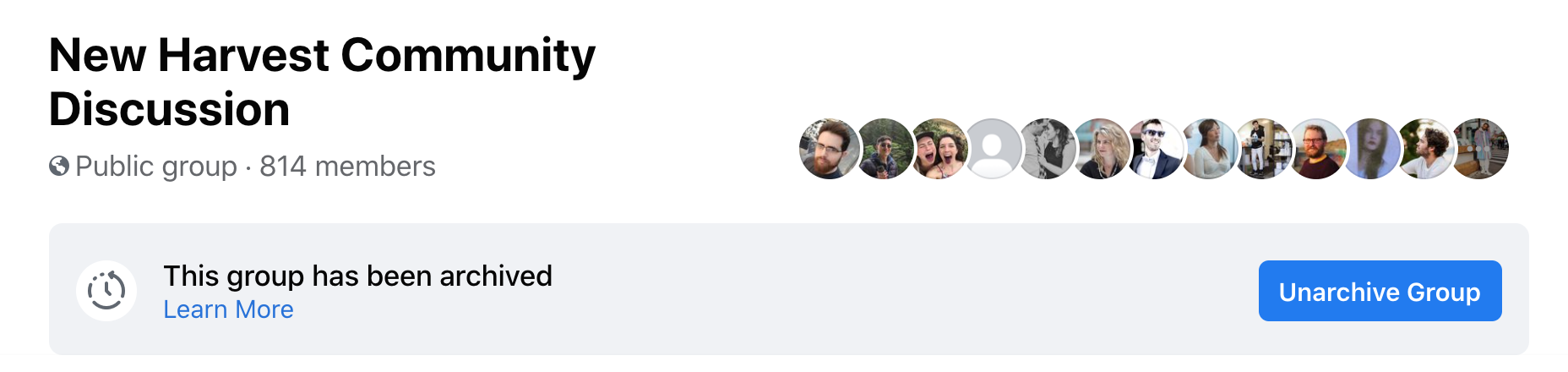
In spring of 2015—the New Harvest community coined the term “cellular agriculture” to describe the field of growing animal products like meat, milk, and eggs from cells instead of animals. We did so in a Facebook thread, which lived inside a now-archived Facebook Group called “New Harvest Community Discussion.”
At the time, no one knew that we were naming a field. We were just 26 people on the Internet, few of whom had met each other but all of whom were into the idea of lab-grown meat. The earliest of early adopters, commenting back and forth and throwing out names like “engineered nutrition” and “cultured consumables” until a loose consensus formed around “cellular agriculture.”
I was one of those 26 people. A sophomore in college and New Harvest volunteer, I was mostly a lurker in the Facebook group. And frankly, I didn’t think “cellular agriculture” would stick.
It’s not that I didn’t like it (I did!), but Isha was asking the group random questions every other day; I simply didn’t think too much of it!

Please note that Isha regrets saying “sexier.” Specifically, she says “cringe.”
Fast forward six years to 2021, and “cellular agriculture” has now been used by the United States Government Accountability Office, in the title of a professorship at the Technical University of Munich, and in over 38 peer-reviewed papers.
Until now, New Harvest hasn’t made this story “official.” We’ve shared screenshots of the thread on Instagram and in our 2016 annual report, but they were blurry and incomplete, capturing only the first half of the thread. The full back and forth was lost to history when Isha, our executive director and original poster of the thread, deleted her Facebook profile and along with it, all of her posts on the platform.
At least, that’s what I thought…
Last week, I recovered the unabridged thread in its entirety.
I was on the phone with Sherrie, one of New Harvest’s oldest volunteers, when she casually dropped that she had printed out a physical copy of the thread after noticing “cellular agriculture” gaining traction outside of the group. Sherrie kept it all these years—in pristine condition—in her filing cabinet under “activism.”

The first page of Sherrie’s print-out, which she generously scanned and emailed to me. Note the timestamp in the top right corner: August of 2015. Sherrie printed out the thread after seeing “cellular agriculture” become popular around the Internet, meaning it was in circulation around the Internet by summer ☀️
👉 Full pdf here
I was shocked!!!!! (But also not shocked at all because of course it would be Sherrie to quietly shepherd New Harvest’s history from cyberspace to meatspace to Panama, where she is currently living.)
I reached out to participants in the thread— messaging them on Facebook, digging up old email addresses, and sending cold LinkedIn requests. What follows is an oral history of “cellular agriculture” and the naming of the field.
In order of appearance…
Isha Datar
Then: Executive Director of New Harvest
Now: Executive Director of New Harvest
“My favorite part of that moment was that it was on Facebook and a true, distributed community effort. This moment is often discussed as the time when ‘Isha’ named the field, but really, it was a moment of collective value creation where we were really strategizing through naming—thinking about the association of the terminology, and really thinking of the ‘need’ the term would fill—a way to talk about the ‘field.’
I feel like a lot of ideas come from ‘jamming’ in a group, playing off of each other and inspiring one another. I especially remember feeling convinced that cellular agriculture was the name when Kevin posted the shorthand form, ‘cell ag.’ I think that shorthand is one of the reasons adoption has spread so quickly!” – Isha Datar
Ben Wurgaft
Then: Postdoctoral researcher at MIT working on a two-year project examining efforts to create cultured meat
Now: Author of Meat Planet: Artificial Flesh and the Future of Food
“I definitely think of Isha as the coiner, but in the spirit that so characterized NH at the time. Isha was trying to make it the product of the community of interest.
It’s possible that if Isha hadn’t coined the term, somebody else might have coined a similar convening term. It’s possible that Isha was running conversations like that on Facebook in response to a sense that people needed something like that; needed a term to cultivate or crystallize nascent interest. It’s very chicken and egg to figure out whether New Harvest at the time was simply catalyzing things that might’ve been catalyzed by something else, or engaging in what people now call thought leadership.
The term has certainly shaped the trajectory of the field. The idea that a meat company, a fish company, and a company that’s interested in egg replacements are all doing something similar to each other is enormously useful, both at the analytical level and for people commenting on the scene. That was big. Probably big in ways I couldn’t see at the time.” – Ben Wurgaft
Natalie Rubio
Then: Pre-med at University of Colorado, Boulder
Now: New Harvest research fellow completing the world’s first cellular agriculture PhD at Tufts University; coined “entomoculture”
“It’s a warm feeling to be part of the naming of the field! The Facebook group itself felt a bit like a home for misfits, haha. Most of the people who sought out in vitro meat content at that time were quirky. To me, it didn’t feel like a network of professionals, it felt more like a welcoming community that housed a bond over our love for a specific piece of technology.
The conversation felt important because of the degree of engagement and interest in the post, but I didn’t notice it as a defining moment in the field’s history at the time. As you can gather from reading the thread, ‘cellular agriculture’ stuck pretty much immediately.
As I remember it, people started to use cellular agriculture immediately or soon after that post, and it fit so well, it was very natural to begin using the term. So I would say it became ‘real’ immediately, to me at least.” – Natalie Rubio
Bruce Chou
Then: Futurist
Now: Futurist
“I’m a true believer [in cell ag] but I don’t really get too involved anymore. It feels great of course, but as a futurist, I’m keeping my eyes on about a hundred things simultaneously so I can’t dwell on any one thing.” – Bruce Chou
Sherrie Tullsen-Chin
Then: Vegan, animal rights activist, and New Harvest volunteer
Now: Custodian of the world’s only unabridged record of the coining of “cellular agriculture”
“It came about organically. I don’t think any of us thought we were naming a new industry, we were just conjecturing and having fun tossing around an idea. Isha was doing a ton of public speaking at the time. She was in a position to take whatever name we decided on and run with it. We didn’t know from there if it would be adopted.
I knew it was real when I saw cell ag start showing up on GFI and other org’s materials. I thought, ‘Oh wow this is a thing now.’ So I went back and printed out the Facebook thread, because it was historic and I needed to have a copy of it. I feel like I was a tiny part of the making of history!
It’s a great term. There hasn’t been any controversy around it, unlike cultured, clean, cultivated…etc. It doesn’t offend anybody. It just describes what it is.” – Sherrie Tullsen-Chin
Kevin Chen
Then: CEO and co-founder of Hyasynth Bio
Now: CEO and co-founder of Hyasynth Bio
“I would say ‘cellular agriculture’ became real to me when either a journalist or investor described us as a cell ag company. When the word became popular in enough circles that we put it in our deck. There are other words to describe the field but that’s the most interesting one to me in terms of the evolution of the terminology.
We’re a little different because we’re not in the meat space. We’re using cell ag to make cannabanoids. So with the type of investor we’re dealing with, we can call it whatever we want and they don’t care that much. They just understand the technology to the core. So it’s been interesting over time to see what words people choose to use in describing our company. Sometimes we don’t call ourselves a cell ag company, and sometimes we do. In our latest stuff we actually don’t use any mention of cellular agriculture, but it comes back every now and then.” – Kevin Chen
Barnaby Dawson
Then: Passionate but pragmatic vegetarian
Now: Engineering Manager at Sainsbury’s; still interested in cell ag but no longer a main interest
“I actually created a Facebook page for New Harvest before the group existed (I asked permission of then-leader of New Harvest Jason Matheny, if I recall correctly). Later on I joined the group when it was formed. I’m certainly chuffed although I don’t feel very responsible for the choice. People picked up on the abbreviation ‘cell ag’ so quickly, identifying it as a term easy to build a buzz around. I think the important point is that the name was a good one and is helping the research programme and political programme in a small but significant way.” – Barnaby Dawson
Kevin Mayo
Then: Hobbyist programmer, musician, and gamer who thinks that we as humans could do a lot better; prophet*
Now: Edmonton-based software engineer
“It definitely felt like the early stages of something that could be world changing.
I was interested in the potential of cellular agriculture and excited about what Isha was doing. She asked for my opinion on dealing with some cryptocurrency stuff and I just weighed in on that convo. I feel like I was mostly just a nosey and noisy observer. I just agreed with Isha’s decision for a name.” – Kevin Mayo

*Predicted that “cell ag” would become universal shorthand for “cellular agriculture.”
Ryan Pandya
Then: Co-founder of Muufri
Now: Co-founder and CEO of Perfect Day Foods (formerly known as Muufri)
“I actually had completely forgotten about this thread until you reminded me. This was just one of many, many nomenclature conversations I’ve been a part of over the last seven years.
Perfect Day is a company utilizing ‘precision fermentation’ to create ‘non-animal whey protein’ using ‘(micro) flora’ to pioneer a new food category of ‘animal-free dairy.’ It’s kind of crazy how much naming we get to do as part of this journey.
‘Cellular agriculture’ is not really a consumer phrase, the same way ‘precision fermentation’ is not intended to be a consumer phrase. It’s a disambiguation that is useful for people who are talking about an umbrella category. Meaning we only really talk about precision fermentation in the context of other kinds of fermentation, and we only talk about cellular agriculture when we need to refer to the larger category of things that includes both Perfect Day and cell-based (cultivated? cultured?) meat.
These terms have the potential to become more mainstream and consumer-relevant once there are products in market. As far as I can tell, though, meat is still a long way off. For now, cell ag (which is what I more frequently think of it as) really just refers to a scientific discipline that has a lot of work to do.” – Ryan Pandya
Kevin Schneider
Then: Newly minted attorney in NYC; volunteer at Nonhuman Rights Project and long-term fan of meat replacements
Now: Executive Director of the Nonhuman Rights Project
“You have to give people a slogan to rally around. I didn’t even think I was part of it, but now looking back and seeing the receipts, I guess I was! Really, it makes me validate my own thinking. I knew right away when I heard Isha speak and looked into New Harvest that the org was going to do really important things. I mostly watch from the outside and volunteer at the conference. But being able to contribute the little bits that I have…it’s kind of crazy. And definitely an honor.” – Kevin Schneider
Erin Kim
Then: Law student at University of Alberta and New Harvest volunteer
Now: Communications Director at a biodesign company
“Cellular agriculture as a concept began to feel real for me the minute I discovered New Harvest—before we even had a name for it. As the thread shows, we experimented with different names in those early days, including the ‘post-animal bioeconomy,’ but ‘cellular agriculture’ seemed to resonate with a wide variety of different stakeholders right away. I can’t pinpoint an exact moment when we transitioned to that terminology, but it had to have been sometime pretty soon after, in 2016 or so.
It was an important conversation then, and I think it will remain an important conversation well into the future. Nothing about this industry, including how we talk about it, is settled at the moment.” – Erin Kim
NAMING “CELLULAR AGRICULTURE”
Outcomes
“Cellular agriculture” has been used in numerous articles, peer-reviewed publications, and official government documents.
“Cellular agriculture” has been applied to the names of professorships, institutes, and over a dozen national organizations.
NAMING “CELLULAR AGRICULTURE”
Collaborators
The ongoing storytelling of this moment in New Harvest’s history has been upheld by Meera Zassenhaus, former New Harvest intern and employee.
The collaborators involved in deciding on cellular agriculture can all be seen in the print-out of the original Facebook thread.