
Canadian Novel Food Regulatory Resource
A case overview for startups and food/biotech professionals in the cell ag space
Canada 2026
Bringing a cellular agriculture food product to market in Canada requires navigating a multi-agency regulatory process that can feel overwhelming without a clear roadmap.
Health Canada, the Canadian Food Inspection Agency (CFIA), and Environment and Climate Change Canada (ECCC) each play distinct roles with different submission processes and timelines. For founders and researchers moving from bench to market, the regulatory pathway is much like preparing a manuscript for peer review: petitioners clearly describe the science behind the product, the production inputs, the manufacturing process, the characterization of the finished food or ingredient, its intended use, and the evidence supporting its safety. All claims must be backed by data or scientifically valid rationale.
The Canadian Cellular Agriculture Regulatory Resource is an independent educational tool for food and biotech founders and researchers preparing to launch a novel food product in Canada. It is NOT an OFFICIAL government guide, but it is built directly from official guidelines, organized into seven regulatory phases with practical templates, checklists, and consultation tools designed to make each step more approachable.
Estimated timelines are included throughout as a planning reference. They are informative only, since your actual timeline will depend on your specific requirements, the completeness of your data and dossier, and the agencies involved. Use them as a starting point, not a guarantee.
Take a glimpse at the regulatory process for novel foods!
Click and explore the phases that bring your novel product a step closer to the market.
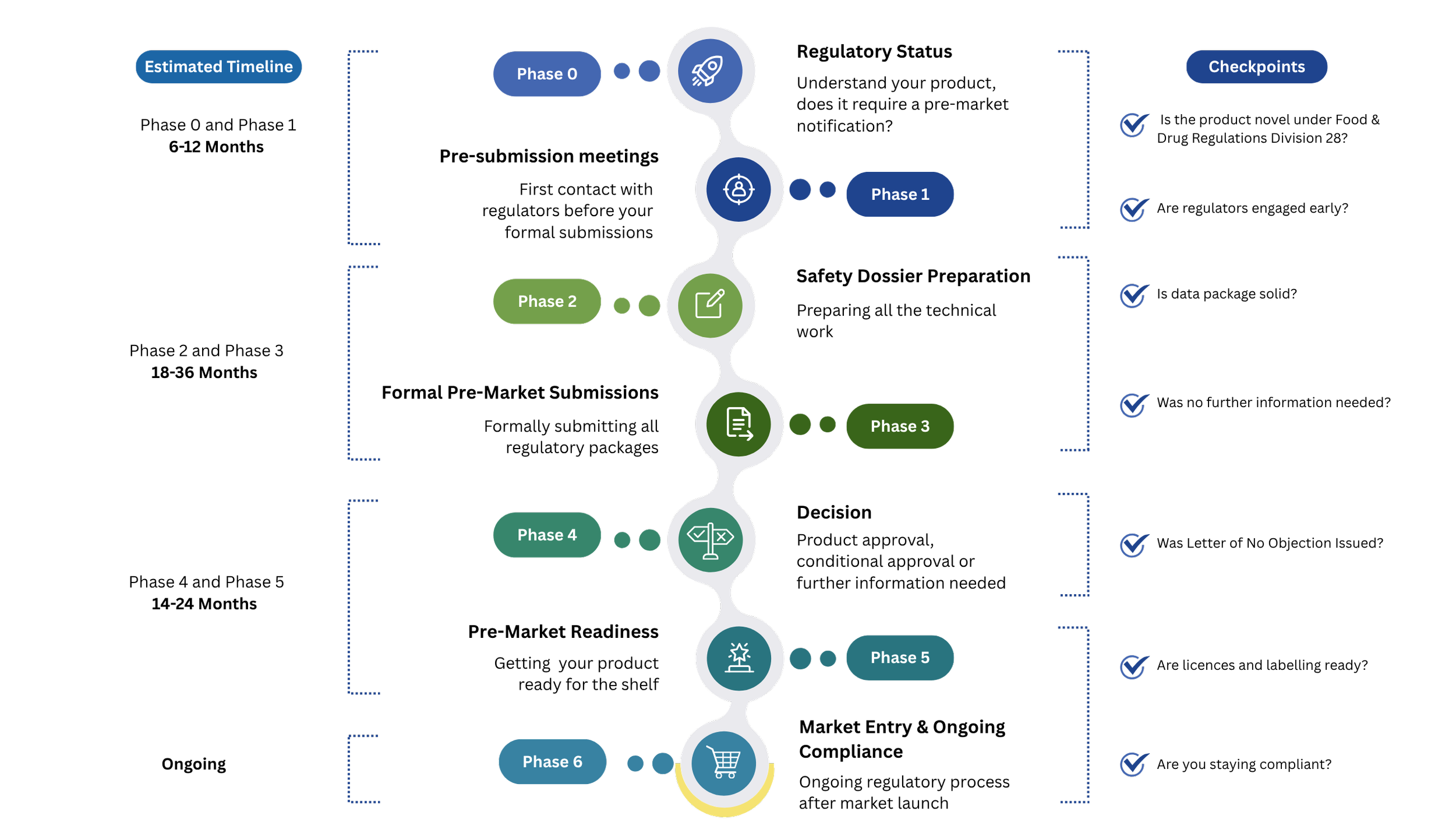
DISCLAIMER: Actual timelines and requirements may vary depending on product characteristics, data gaps, and regulatory feedback. AWARENESS TOOL ONLY, NOT OFFICIAL GOVERNMENT GUIDANCE. This roadmap is an independent educational resource. It does not constitute legal or regulatory advice. Always verify requirements with Health Canada, CFIA, and ECCC.

Phase 0: Regulatory Status
Before engaging any regulatory agency, its important to understand what your product actually is from a regulatory standpoint.
This phase is about building that foundation, characterizing your product, documenting your production process, and determining whether it qualifies as a "novel food" under Division 28 of the Food and Drug Regulations.
The outcome of this phase is a clear answer to: does your product require a pre-market notification before it can be sold in Canada?
-
The Food and Drug Regulations Division 28 establish the legal definition of a “novel food”.
These definitions apply to foods and food ingredients intended for nutritive purposes.
Review the full definition here and use our template to assess whether your product meets any of the three triggers.
🔗Relevant Links:
-
Define cell source, organism type, growth media, scaffolding, final form and intended use
If your product (or any manufacturing input) performs a technical function, it may be considered a food additive requiring pre‑market assessment under FDR B.16, or a processing aid, which does not require pre‑market assessment. Flavours fall under FDR B.10
If you use third‑party inputs, even those transformed or removed during manufacturing (e.g., media components, growth factors) you must ensure the necessary characterization and safety information is included in your novel food submission
If any developed product is intended for animal feed, early verification against CFIA Feeds Regulations 2024 is recommended
👤Entity: Internal Team
🔗Relevant Links:
-
If after reading the novel food definition you are still unsure whether your product is novel, you may request a novelty determination from Health Canada on a voluntary basis. This step is optional and there is no cost
This request is an optional step in the process if determined internally by the company
If you’re unsure about the regulatory status of a product or input, you can contact Health Canada, Submission Management and Information Unit at: smiu-ugdi@hc-sc.gc.ca | 613-960-0552
Someone from their team will contact you in the next few days after emailing them
If in doubt, ECCC also offers pre‑assessment consultations to clarify requirements
Submit Novelty Determination Information Form to Health Canada
👤Entity: Health Canada, Submission Management and Information Unit
👤Entity (optional clarification): ECCC — available for early pre‑assessment consultations to clarify regulations or requirements
🔗Relevant Links:
-
Is the product novel under Food & Drug Regulations Division 28?
🔴No: General food regulations apply.
You must still ensure compliance with any relevant provisions of the Food and Drugs Act, Food and Drugs Regulation, and the Safe Food Canadians Regulations (e.g., additives, flavourings, fortification, standards of identity, labelling, and FDA Sections 4–5). Verify labelling with CFIA
🟢YES: Proceed to Phase 1
Awareness tool only, NOT an official government guidance

Phase 1: Pre-submission meetings
Once novelty is confirmed, the next step is getting in front of the regulators before you submit anything formal.
This phase covers early consultations with the Food and Nutrition Directorate, the CFIA, and ECCC. This step gives your team the opportunity to clarify data requirements, flag potential issues early, and build a relationship with the agencies that will review your product.
These meetings are optional but strongly recommended; they routinely save months of back-and-forth later.
-
SMIU invites regulators from food, feed, and environmental groups to the meeting, as applicable
👤Entity: Health Canada, Submission Management and Information Unit, Food and Nutrition Directorate
Email address:smiu-ugdi@hc-sc.gc.ca
🔗Relevant Links:
-
Consultation may be in person, by conference call or video conference.
Bring product brief background, agenda, and question list
Agenda template (commonly followed format)
Following the consultation, draft your meeting minutes and send it to other attendees (e.g., HC, CFIA, ECCC) for review and post meeting clarifications
Send this first draft to SMIU within 2 weeks
Minutes represent a summary of the discussion rather than a verbatim of the discussion
👤Entity: Internal
🔗Relevant Links:
-
Discuss SFCR licensing, Preventive Control Plan (PCP), traceability, and labelling expectations.
👤Entity: CFIA
🔗Relevant Links
-
Pre-assessment meetings are available to discuss regulatory expectations
Check if cell lines/organisms are on Domestic Substances List (DSL)
ECCC requires organism identification down to the strain level, including any genetic modifications; DSL matches must be exact
👤Entity: ECCC/ CEPA
Contact: substances@ec.gc.ca
1-800-567-1999 (Toll free in Canada)
1-819-938-3232 (Outside of Canada)
🔗Relevant Links:
Templates:
Administrative Information
Technical information
Awareness tool only, NOT an official government guidance

Phase 2: Safety Dossier Preparation
This is where the technical work happens.
Using the guidance received in Phase 1, your team builds the two core submission packages: the Novel Food Notification (NFN) dossier for Health Canada, and the New Substances Notification dossier for ECCC under Canadian Environmental Protection Act (CEPA).
Expect this to be the longest and most resource-intensive phase. The quality, organization, compliance, and completeness of what you build here directly impacts how smoothly the formal review goes.
Your safety dossier must present a clear, complete, and evidence-supported story of the product’s characterization, safety, and intended uses.
-
Present a story that’s clear, complete, and supported by evidence:
Include product’s characterization, safety, and intended uses
Claims should be backed by appropriate evidence, which may include studies on the product or scientifically valid rationale
Health Canada is not prescriptive about specific methods, as long as all required safety end‑points are addressed
The quality of data should be comparable to what would be submitted to a peer‑reviewed scientific journal
Review the relevant links to understand expectations for how to organize your dossier and the safety considerations that can be mirrored in a notification package
If diverted batches or manufacturing byproducts could enter the animal feed supply, petitioners must also consider obligations under the CFIA Feeds Regulations
👤Entity: Internal Team
🔗Relevant Links:
-
Companies must proactively demonstrate their cultured or precision fermented products are nutritionally adequate and biologically safe to conventional foods before they can legally enter the Canadian market.
Notification sent electronically through the Application Form for Pre-Market Submissions to the Food Directorate (Online Application Form)
Submission of a safety assessment data package
Molecular & cellular characterization, cell line stability, manufacturing process, chemical safety, nutritional assessment, allergenicity assessment, microbial safety, proposed use & dietary exposure assessment
Make a formal submission to Health Canada well before planned launch
👤Entity: Internal Team
🔗Relevant Links:
-
A New Substances Notification (NSN) under the Canadian Environmental Protection Act (CEPA) is not a requirement for every company at this phase. It is entirely volume- and risk-dependent.
Prepare New Substances Notification per ECCC Guidelines for Organisms BEFORE manufacturing or importing a new living organism in Canada
For cultured cells, some R&D exceptions may still apply under CEPA; consult the CEPA definition of “micro-organism” to determine applicability
Precision Fermentation Products
Importing: Cell or microorganism-free final product? The NSN rule does not apply because you are not importing a living organism
Domestic: Doing domestic R&D or scale-up? You must evaluate your volume thresholds, as brewing the organism inside Canada triggers the requirement
Cultivated Meat Products
The cells are the product. Whether manufacturing domestically or importing raw biomass, you are handling a living organism and must submit your dossier before operations or shipments begin
👤Agency: ECCC/ CEPA
Substances Management Information Line:
1-800-567-1999 (in Canada)
1-819-938-3232 (outside of Canada)
E-mail:substances@ec.gc.ca
🔗Relevant Links:
Awareness tool only, NOT an official government guidance

Phase 3: Formal Pre-Market Submissions
With your dossiers ready, this phase covers the formal submission of all regulatory packages: the Novel Food Notification to Health Canada, the New Substances Notification to ECCC, and your Safe Food for Canadians Regulations (SFCR) licence application and Preventive Control Plan to CFIA.
This phase also includes a key decision point: if agencies request additional information, your team will need to respond promptly to keep the process moving.
Health Canada’s regular service standard for Novel Food assessments is 410 calendar days, so you should submit well before your planned product launch. It could take longer depending on the complexity of the file, quality of the submission, and response times from questions to proponents that are raised during review.
-
Verify provincial food safety acts (ON, BC, QC, AB) and municipal zoning for facility
Some provinces require permits for intraprovincial sale, and identifying these needs upfront helps prevent delays
👤Entity: Internal Team
🔗Relevant Links:
-
SFCR license is issued to businesses conducting food-related activities, such as manufacturing, trading, importing, or preparing food products for export or to be send across provinces.
PCP requires a highly structured, written plan based on HACCP principles.
Apply via My CFIA. Prepare Preventive Control Plans (PCP) and traceability system (1-step forward/back).
👤Entity: CFIA
🔗Relevant Links:
-
Joint Health Canada + ECCC review of New Substances Notification (NSN).
Ahead of the decision, evaluators often request clarifications or additional information; if a requirement is missing, the assessment timeline may be paused
Products that involve living organisms (e.g., novel foods, cellular agriculture, food additives) undergo CEPA ecological risk assessment.
Possible outcomes:
No toxicity: Approved for unlimited use
Conditional/Significant New Activity (SNAc): Approved only for the specific notified activity
Suspected toxicity: Restricted, prohibited, or requires more data
Entity: ECCC/ CEPA
🔗Relevant Links:
-
Submit via Health Canada Online Application Form for the submission of novel food applications to the Food and Nutrition Directorate.
The Food and Nutrition Directorate will notify you in writing of its decision for most submissions within 410 calendar days from the date your notification is received.
If HC cannot complete the review and reach a decision within that timeframe (for example, if policy or regulatory questions need to be resolved) they will inform you promptly.
Email to the Submission Management and Information Unit (SMIU) at smiu-ugdi@hc-sc.gc.ca for:
Novelty Determinations
👤Entity: Health Canada
🔗Relevant Links:
-
Health Canada’s Food and Nutrition Directorate evaluates Novel Food notifications through four phases:
1. Administrative screening
After you submit your notification, HC performs an administrative check to confirm the package is complete. If everything is in order, you will receive a Letter of Acknowledgment confirming that your submission has been accepted for scientific review.
2. Scientific screening (45 days)
Scientific screening is completed within 45 calendar days from the date your Letter of Acknowledgment is issued.
If HC identifies major gaps, you will be asked to provide the missing information within 14 calendar days. You will be notified of the results of scientific screening once it is complete.
3. Review phase
During the review phase, HC may request additional information. You have up to 90 calendar days to provide a satisfactory response, although shorter deadlines are often set for straightforward questions or clarifications.
The review timeline continues during exchanges of additional information; HC does not pause the clock when requesting clarifications.
If you do not provide an adequate response within the specified timeline, HC will close the submission, but you can reapply later. You may also request to withdraw your submission at any time.
If significant deficiencies or safety concerns arise during scientific review, HC may close the file and communicate the decision to you. However, in almost all cases, HC will first give you an opportunity to address deficiencies through a request for information.
4. Decision
For most submissions, HC will notify you in writing of its decision within 410 calendar days from the date your notification was received.
-
Does Health Canada requested additional information?
🔴Yes: Respond via Transport Form to SMIU; (+90 days max)
🟢NO: Assessment continues on 410-day timeline. Proceed to Phase 4
👤Entity: Health Canada
🔗Relevant Links:
Awareness tool only, NOT an official government guidance

Phase 4: Decision
Your submissions are now under formal review.
Health Canada's Food Rulings Committee (FRC) is the decision-making body that issues the final approval after reviewing the safety assessment completed by Health Canada’s pre-market evaluation team.
This phase ends at a critical decision point: approval to sell the product as described, or a request for further information. While in the hands of the regulators at this stage, staying organized and responsive is essential.
-
The completed assessment is presented to the Food Rulings Committee (FRC) for decision
HC Director General chairs and CFIA participates
If Committee reaches a favourable decision, Health Canada prepares a plain language and technical summary of the evaluation
You will have the opportunity to review these documents for confidential information before they are published online
👤Entity: Health Canada & CFIA
🔗Relevant Links:
-
Assessment outcome:
MORE DATA: Respond via Transport Form; up to +90 days
REFUSED: Product cannot be sold; reformulate or restart
SUCCESSFUL ASSESSMENT: If the FRC approves your product, you will receive a Letter of No Objection (LONO) permitting its sale in Canada.
At this stage, the assessment is complete and no further data will be requested.
Decision document posted on Health Canada Website
Go to Phase 5
👤Entity: Health Canada
🔗Relevant Links:
Templates:
Awareness tool only, NOT an official government guidance

Phase 5: Pre-Market Readiness
With regulatory decisions in hand, the focus shifts to getting everything ready for the shelf!
Even with a Letter of No Objection, you must comply with all applicable requirements under the FDA/FDR and SFCA/SFCR, including composition, labelling, claims, and any product-specific rules that apply to foods sold in Canada.
This phase covers confirming your SFCR licence and Preventive Control Plan with CFIA, finalizing your product labelling in compliance with Canadian requirements, and completing any provincial or municipal checks required in your specific market.
These steps should run in parallel with Phase 3 where possible.
-
Confirm that your SFCR license is issued to you via My CFIA
To obtain a Safe Food for Canadians (SFC) licence under the SFCA/SFCR, you don’t need to have your product labels finalized or approved by CFIA before the licence is issued
👤Entity: CFIA
🔗Relevant Links:
-
Your labels must fully comply with all applicable requirements before the product is sold, imported, exported, or traded in any context where labelling rules apply
Bilingual (EN/FR), common name, net quantity, nutrition facts table, ingredients, name & address.
Front-of-package (FOP) symbol mandatory from Jan 1, 2026 if high sat. fat/sugar/sodium
👤Entity: CFIA
🔗Relevant Links:
Industry Labelling Tool (Interactive requirements checker)
Templates:
Awareness tool only, NOT an official government guidance

Phase 6: Market Entry & Ongoing Compliance
At this point your product is on the market, but the regulatory process doesn’t end at launch. Your must continue producing safe food, which means keeping your Preventive Control Plan, sanitation programs, and hazard controls fully in place as you scale.
This phase covers your ongoing obligations: post-market surveillance, CFIA inspections and compliance monitoring, animal feed licensing if your process generates co-products intended for feed use, and the requirements that kick in if you scale production beyond the quantities described in your original New Substances Notification.
Building good compliance habits here protects everything you built to get here.
-
HC does not require routine post‑market surveillance data for novel foods
If new information arises after authorization that could affect the safety of your product, you must notify regulators
Entity: Health Canada
Relevant Links:
-
Risk-based inspection model
Maintain your complaint and recall system.
Report material changes only if they add a new product category or activity that triggers a change to your SFCR licence
Continue producing a safe food by maintaining your PCP, monitoring hazards, and ensuring your process remains consistent with what was authorized
👤Entity: CFIA
🔗Relevant Links:
-
If any cell-ag byproduct enters animal feed stream, separate license is required.
In effect Dec 17, 2025.
👤Entity: CFIA
🔗Relevant Links:
-
If manufacturing scales beyond original NSN quantities a re-notification required.
Additional manufacturing sites also require notification and may trigger re-evaluation under CEPA.
During re-evaluation, ECCC may reference past submissions to confirm consistency.
Continue monitoring for Significant New Activity (SNAc) triggers.
👤Entity: ECCC / CEPA
🔗Relevant Links:
SNAc notices explained (Re-notify at volume thresholds)
Significant new activity provisions: Canadian Environmental Protection Act
-
CEPA and the NSNR(O) provide mechanisms to protect proprietary information, including masked names and confidential business information.
When production activities begin, a letter stating so must be transmitted to ECCC — only if an evaluation was completed by ECCC.
👤 Entity: ECCC / CEPA
Awareness tool only, NOT an official government guidance
Congratulations on getting your product approved and launched!
Reaching the end of these steps means you’ve navigated the full pathway from concept to market. We hope this educational guide supported you along the way and we encourage you to continue consulting official government resources to stay fully compliant as your business grows.