
Canadian Novel Food Regulatory Resource
A case overview for startups and food/biotech professionals in the cell ag space: Canada 2026
Bringing a cellular agriculture product to market in Canada requires navigating a multi-agency regulatory process that can feel overwhelming without a clear roadmap.
Health Canada, the Canadian Food Inspection Agency (CFIA), and Environment and Climate Change Canada (ECCC), each play a distinct role, submission processes, and timelines. For founders and researchers moving from bench to market, understanding where to start, what to prepare, and who to talk to can be as difficult as the science itself.
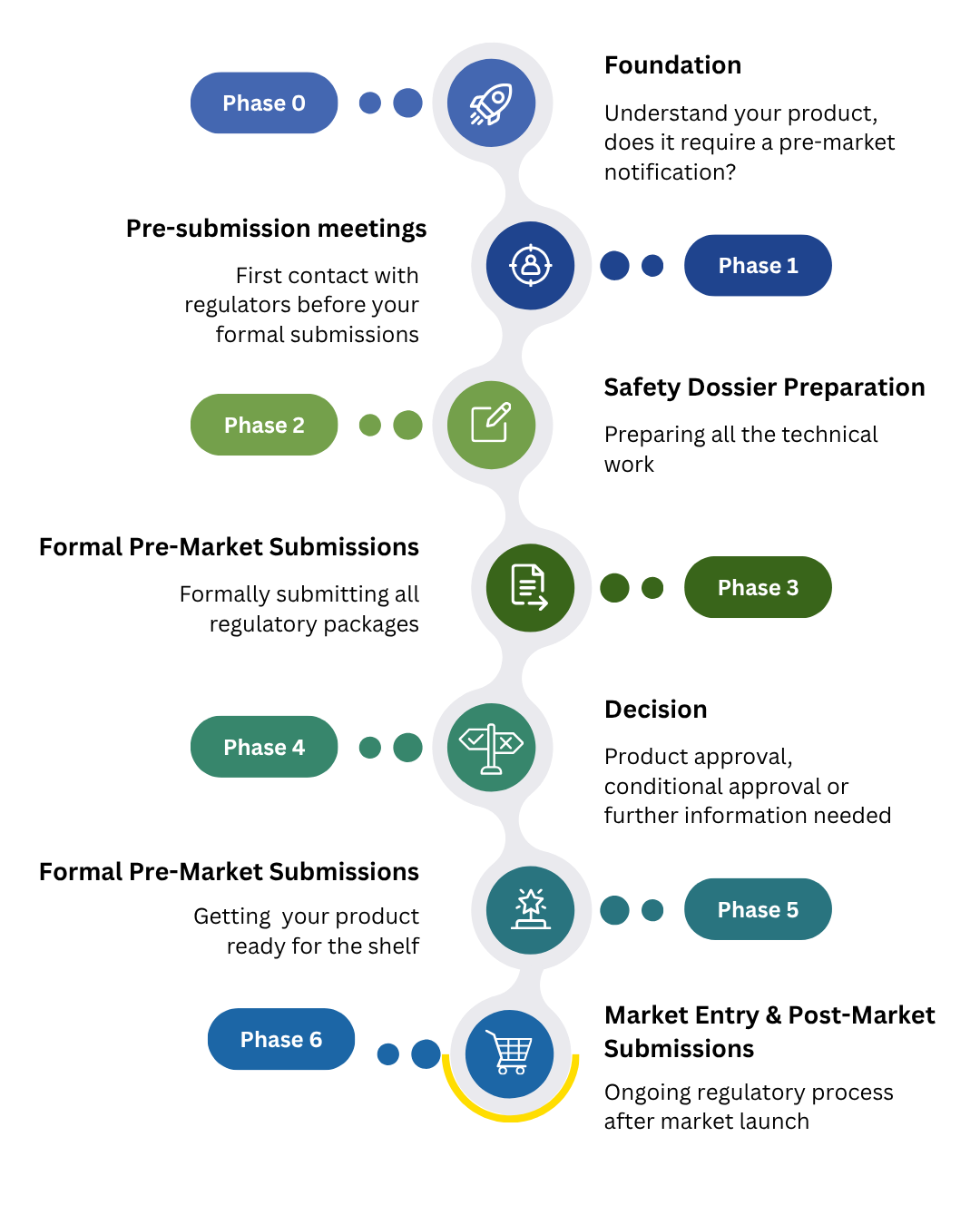
The Canadian Cellular Agriculture Regulatory Resource is an independent educational tool for food and biotech founders and researchers preparing to launch a novel food product in Canada. It is not an official government guide, but it is built directly from official guidelines, organized into seven regulatory phases with practical templates, checklists, and consultation tools designed to make each step more approachable.
Estimated timelines are included throughout as a planning reference. Every product is different, and your actual timeline will depend on your specific requirements and the agencies involved. Use them as a starting point, not a guarantee.
Take a glimpse at the regulatory process for novel foods!
Click and explore the phases that bring your novel product a step closer to the market.
DISCLAIMER: Actual timelines and cost requirements may vary depending on product characteristics, data gaps, and regulatory feedback. AWARENESS TOOL ONLY, NOT OFFICIAL GOVERNMENT GUIDANCE. This roadmap is an independent educational resource. It does not constitute legal or regulatory advice. Always verify requirements with Health Canada, CFIA, and ECCC.
〰️
DISCLAIMER: Actual timelines and cost requirements may vary depending on product characteristics, data gaps, and regulatory feedback. AWARENESS TOOL ONLY, NOT OFFICIAL GOVERNMENT GUIDANCE. This roadmap is an independent educational resource. It does not constitute legal or regulatory advice. Always verify requirements with Health Canada, CFIA, and ECCC. 〰️
Go to:
Phase 0: Foundation
Before engaging any regulatory agency, its important to understand what your product actually is from a regulatory standpoint.
This phase is about building that foundation, characterizing your product, documenting your production process, and determining whether it qualifies as a "novel food" under Division 28 of the Food and Drug Regulations.
The outcome of this phase is a clear answer to: does your product require a pre-market notification before it can be sold in Canada?
-
Define cell source, organism type, growth media, scaffolding, final form and intended use.
👤Entity: Internal Team
🔗Relevant Links:
-
Optional step in the process if determined internally by the company. Otherwise, contact: smiu-ugdi@hc-sc.gc.ca | 613-960-0552
Someone from their team will contact you in the next few days after emailing them.
Submit Novelty Determination Information Form to Health Canada
👤Entity: Health Canada
🔗Relevant Links:
-
Is the product novel under Food & Drug Regulations Division 28?
🔴No: General food regulations apply; verify labelling with CFIA
🟢YES: Proceed to Phase 1
Phase 1: Pre-submission meetings
Once novelty is confirmed, the next step is getting in front of the regulators before you submit anything formal.
This phase covers early consultations with Health Canada's Food Directorate, the CFIA, and ECCC. This step gives your team the opportunity to clarify data requirements, flag potential issues early, and build a relationship with the agencies that will review your product.
These meetings are optional but strongly recommended; they routinely save months of back-and-forth later.
-
👤Entity: Health Canada
Novel Food Section:
Submission Management and Information Unit
Food Directorate, Health Products and Food Branch
Health Canada✉️ Email address:smiu-ugdi@hc-sc.gc.ca
🔗Relevant Links:
-
Consultation may be in person, by conference call or video conference.
Bring product brief background, agenda, and question list
Agenda template (commonly followed format)
Following the consultation, review the consultation summary document provided
👤Entity: Internal
🔗Relevant Links:
-
Discuss SFCR licensing, Preventive Control Plan (PCP), and labelling expectations
👤Entity: CFIA
✉️Email address: cfia.afp-paa.acia@inspection.gc.ca
🔗Relevant Links
-
Check if cell lines/organisms are on Domestic Substances List (DSL).
👤Entity: ECCC/ CEPA
✉️📞Contact: substances@ec.gc.ca | 1-800-567-1999
🔗Relevant Links:
Templates:
Administrative Information
Technical information
List of questions to discuss
Phase 2: Safety Dossier Preparation
This is where the technical work happens.
Using the guidance received in Phase 1, your team builds the two core submission packages: the Novel Food Notification (NFN) dossier for Health Canada, and the New Substances Notification dossier for ECCC under CEPA.
Expect this to be the longest and most resource-intensive phase, the quality of what you build here directly impacts how smoothly the formal review goes.
-
Companies must proactively prove their cultured or precision fermented products are nutritionally equivalent and biologically safe to conventional foods before they can legally enter the Canadian market.
Notification sent electronically through the Application Form for Pre-Market Submissions to the Food Directorate (Online Application Form) 📩
Submission of a safety assessment data package
Molecular & cellular characterization, cell line stability, manufacturing process, chemical safety, nutritional assessment, allergenicity assessment, microbial safety, proposed use & dietary exposure assessment.
Notify Health Canada well before launch; they must respond with a safety decision or data request within 45 days.
👤Entity: Internal Team / Health Canada
🔗Relevant Links:
-
A New Substances Notification (NSN) under the Canadian Environmental Protection Act (CEPA) is not a requirement for every company at this phase. It is entirely volume- and risk-dependent.
Prepare New Substances Notification per ECCC Guidelines for Organisms BEFORE manufacturing or importing a new living organism in Canada.
Precision Fermentation Products
Importing: Cell or microorganism-free final product? The NSN rule does not apply because you are not importing a living organism.
Domestic: Doing domestic R&D or scale-up? You must evaluate your volume thresholds, as brewing the organism inside Canada triggers the requirement.
Cultivated Meat Products
The cells are the product. Whether manufacturing domestically or importing raw biomass, you are handling a living organism and must submit your dossier before operations or shipments begin.
👤Agency: ECCC/ CEPA
Substances Management Information Line: 1-800-567-1999 (in Canada) or 1-819-938-3232 (outside of Canada)
✉️E-mail:substances@ec.gc.ca🔗Relevant Links:
Phase 3: Formal Pre-Market Submissions
With your dossiers ready, this phase covers the formal submission of all regulatory packages: the Novel Food Notification to Health Canada, the New Substances Notification to ECCC, and your Safe Food for Canadians Regulations (SFCR) licence application and Preventive Control Plan to CFIA.
This phase also includes a key decision point: if agencies request additional information, your team will need to respond promptly to keep the process moving.
-
SFRC license is issued to businesses conducting food-related activities, such as manufacturing, trading, importing, or preparing food products for export or to be send across provinces.
PCP requires a highly structured, written plan based on HACCP principles.
Apply via My CFIA. Prepare Preventive Control Plans (PCP) and traceability system (1-step forward/back).
👤Entity: CFIA
🔗Relevant Links:
-
Joint Health Canada + ECCC review of New Substances Notification (NSN).
Foods (such as novel foods, cellular agriculture, food additives) using living organisms.
Possible outcomes:
No toxicity: Approved for unlimited use
Conditional/Significant New Activity (SNAc): Approved only for the specific notified activity
Suspected toxicity: Restricted, prohibited, or requires more data
Entity: ECCC/ CEPA
🔗Relevant Links:
-
Submit via Health Canada Online Application Form for the submission of novel food applications to the Food and Nutrition Directorate.
Email to the Submission Management and Information Unit (SMIU) at smiu-ugdi@hc-sc.gc.ca for:
Novelty Determinations
👤Entity: Health Canada
🔗Relevant Links:
-
Does Health Canada requested additional information?
🔴Yes: Respond via Transport Form to SMIU; clock paused (+90 days max)
🟢NO: Assessment continues on 410-day timeline. Proceed to Phase 4
👤Entity: Health Canada
🔗Relevant Links:
Phase 4: Decision
Your submissions are now under formal review.
Health Canada's Food Rulings Committee evaluates the safety of your product, and ECCC concludes its ecological risk assessment.
This phase ends at a critical decision point: approval, conditional approval, or a request for further information. While in the hands of the regulators at this stage, staying organized and responsive is essential.
-
HC Director General chairs and CFIA participates
Review safety assessment proposal.
👤Entity: Health Canada & CFIA
🔗Relevant Links:
-
Assessment outcome?
MORE DATA: Respond via Transport Form; up to +90 days
REFUSED: Product cannot be sold; reformulate or restart
SUCCESSFUL ASSESSMENT: Letter of No Objection issued and sent to petitioner; legal to sell from letter date
Decision document posted on Health Canada Website
Go to Phase 5
Entity: Health Canada
Relevant Links:
Phase 5: Formal Pre-Market Submissions
With regulatory decisions in hand, the focus shifts to getting everything ready for the shelf!
This phase covers confirming your SFCR licence and Preventive Control Plan with CFIA, finalizing your product labelling in compliance with Canadian requirements, and completing any provincial or municipal checks required in your specific market.
These steps are should run in parallel with Phase 4 where possible.
-
Confirm that your SFRC license is issued to you via My CFIA
Entity: CFIA
Relevant Links:
-
Bilingual (EN/FR), common name, net quantity,
nutrition facts table, ingredients, name & address.
Front-of-package (FOP) symbol mandatory from Jan 1, 2026 if high sat. fat/sugar/sodium
Agency: CFIA
Relevant Links:
Industry Labelling Tool (Interactive requirements checker)
-
Verify provincial food safety acts (ON, BC, QC, AB) and municipal zoning for facility.
Entity: Internal Team
Relevant Links:
Phase 6: Market Entry & Post-Market
In this point your product is on the market, but the regulatory process doesn’t end at launch.
This phase covers your ongoing obligations: post-market surveillance, CFIA inspections and compliance monitoring, animal feed licensing if your process generates co-products intended for feed use, and the requirements that kick in if you scale production beyond the quantities described in your original New Substances Notification.
Building good compliance habits here protects everything you built to get here.
-
-
Risk-based inspection model.
Maintain complaint/recall system.
Report material process changes to HC/CFIA.
Agency: CFIA
Relevant Links:
SFCR business toolkit
-
If any cell-ag byproduct enters animal feed stream, separate license is required.
In effect Dec 17, 2025.
Entity: CFIA
Relevant Links:
-
If manufacturing scales beyond original NSN quantities a re-notification required.
Monitor for Significant New Activity (SNAc) triggers
Entity: ECCC / CEPA
Relevant Links:
SNAc notices explained (Re-notify at volume thresholds)